

AI Solutions
AI-Powered Business Execution Platform

For decades, the office equipment dealer (OED) enjoyed a business model that was boring, yet dependable: place a high-speed A3 MFP, wrap it in a five-year lease, and enjoy the predictable margins of a “click-charge” service or managed print services (MPS) contract.
That began to change even before the pandemic, and the unraveling accelerated in the face of work-from-home trends, supply-chain and financial crises, the steady shift to digital workflows, as well as a new generation in the workforce that simply does not print as much. As we move through 2026, the traditional boundaries of the imaging channel are not just blurring; they are being redrawn by a fundamental shift in how businesses acquire technology.
One such example surfaced from the continued migration from A3 devices to A4 alternatives. What was once a supplemental product line for the OED has become the go-to print/scan device for many organizations. As a result, OEDs are increasingly finding themselves running up against not only the competing copier dealer down the street but also the IT services (ITS) provider across town. These providers are no longer content with placing laptops, desktops, servers, and network gear. For the ITS reseller, a printer or MFP is simply another IP-connected endpoint—one that is frequently bundled into a holistic managed services agreement that bypasses the OED entirely. While some dealerships have successfully made the transition to full IT shops, the vast majority have not. On top of that, the growing importance of the distribution channel for handling the logistics of staging and delivering print devices (easier tasks when you are talking A4) further squeezes Main Street OEDs.
The Numbers Tell the Tale
Of the approximately $18 billion in revenue that flowed through the document imaging industry for hardware, supplies, software, and services in 2025, 43% was garnered by OEDs (according to our CompleteView Integrated Forecast). By 2029, total industry revenue will decline to $17 billion, with OED share contracting to 40%. Some of the organic shrinkage in the OED channel is being offset by influx from the OEMs: Ricoh, Xerox, and others have been transitioning their direct small to medium business (SMB) accounts—which are often harder for an OEM to service profitably—to local channel partners to focus on enterprise accounts. That book of business helps, but it can’t mask the underlying weakness indefinitely.
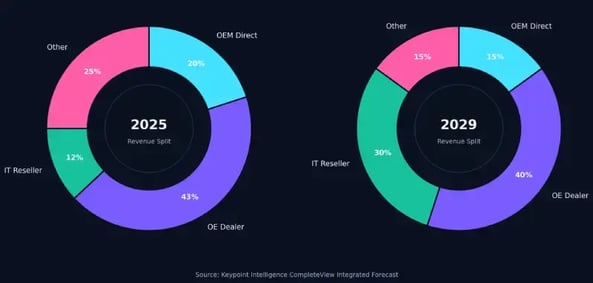
Conversely, our analysts predict that the IT reseller channel will be the net gainer, commanding 30% of document imaging revenue by 2029—up from just 12% today. One reason for the shift is a continued transition from centralized A3-class MFPs to less expensive (to purchase anyway) A4 devices. With fewer people in the office full-time and less printing happening, in general, it becomes harder to justify the higher up-front cost for an A3 MFP. IT buyers realize they may never make up the delta even with A3’s significantly lower cost per page. This will be compounded by the widening availability of faster, more capable A4 devices—“A3 killers” if you will—that offer advanced scanning, finishing, and other features. Yes, A3 MFPs will still dominate in environments where 11″ x 17″ and high-volume output are required, but demand for such hardware at the office level will contract at a rate of 5.6% per year between now and 2030, according to Keypoint Intelligence.
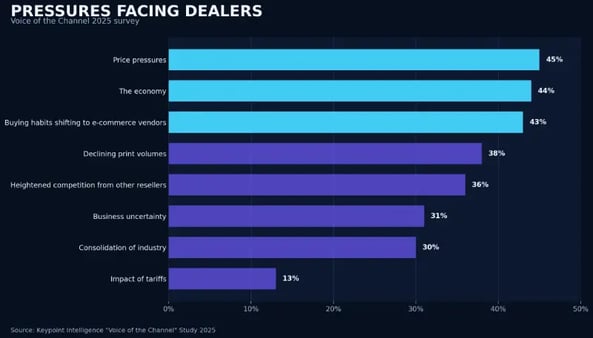
What are dealers themselves saying? In our recent Voice of the Channel Study, Keypoint Intelligence asked dealers to identify the biggest threats to revenue and profits for their businesses. Respondents could select their top three responses, and the results were illuminating. While the expected challenges—price pressures, the economy, e-commerce infiltration, and declining print volumes—were mentioned most often, heightened competition from other resellers was close behind.
The DX Gold Rush: Panning in the Data Stream
There is good news for the industry. There is a gold rush going on in a market that overlaps our own: digital transformation (DX). While some have struggled to defend their legacy hardware margins, forward-looking OEDs have recognized that the value has shifted from the device itself to the data that passes through it. They are pivoting from being “the copier guys” to becoming workflow architects, leveraging mission-critical software platforms to offer high-margin, workflow-centric services that a traditional ITS firm often cannot.
The even better news is that many of the document capture and document management software solutions that OEDs have sold for decades are evolving into artificial intelligence (AI)-powered intelligent document processing (IDP) and intelligent document automation (IDA) platforms. Dealers likely have the required relationships in place with vendors and customers. Notably, a DX opportunity involves a “trusted advisor” type of engagement that OEDs have grown accustomed to.
And the market is expanding. Our annual Document Solutions Forecast—which is based on the conversations we have with OEMs, software developers, and IT-product purchase decision-makers—predicts that the market for advanced IDP and IDA solutions sold through the document imaging industry will grow at a 12% compound annual growth rate from now through 2029. For the OED, this represents a move from low-margin hardware leases and clicks to high-margin, recurring professional services and software-as-a-service (SaaS) revenue.
A Strategic Imperative for Customers, Too
The DX gold rush is indicative of the broader evolution of the digital workplace. For customers, the message is clear: The era of managing print as a siloed utility is over. In 2026 and beyond, the document imaging fleet must be viewed as a critical component of an organization’s data infrastructure and workflow efficiency.
The end game is not about who places the device; it is about who owns the intelligence layer sitting on top of it. As the OED and ITS channels continue to collide, the winners will be the organizations that stop viewing the MFP as a peripheral and start leveraging it as a cornerstone of their customers’ DX strategies. The hardware has become the commodity, and the workflow is the new currency.