2026 TWAIN Converge – Not Your Father's TWAIN Conference
Sign up for The Key Point of View newsletter for more blogs, podcasts, and videos!
For more than three decades, the TWAIN Working Group has been synonymous with document scanning and interoperability. If you worked in the document imaging industry, TWAIN was the technology that helped scanners communicate with software applications, eliminating proprietary barriers and making document capture more accessible. It was important, foundational technology—but hardly something most people would associate with the cutting edge of artificial intelligence or robotics.
Well, times have certainly changed.
The 2026 TWAIN Converge Conference, held November 11–12 at the Safety Harbor Resort & Spa in Florida, demonstrated just how dramatically the organization's vision has evolved. With a focus on AI, automation, data intelligence, and robotics, this year's conference was about much more than connecting scanners to applications. It was about connecting technologies, workflows, and intelligent machines to transform how businesses operate.
And perhaps most importantly, it was about creating new business opportunities for an industry searching for growth beyond traditional printing and document capture.
From Document Capture to Intelligent Automation
The evolution of TWAIN reflects a much larger transformation occurring across the office technology industry. For years, the emphasis was on digitizing paper documents, extracting information, and moving that information into business applications.
Today, simply capturing information is no longer enough.
Artificial intelligence is changing what happens after a document is scanned. Intelligent document processing (IDP), large language models (LLMs), and increasingly autonomous AI agents can classify documents, extract meaningful information, interpret context, and initiate business processes with significantly less human intervention.
TWAIN Converge 2026 embraced this transition, exploring how open standards can support the next generation of intelligent workflows.
Sessions addressing AI in records management, document processing, governance, and content authenticity reinforced an important message: interoperability remains essential, but its role is expanding from connecting devices to enabling intelligent business processes.
The opportunity is no longer simply getting information into a system. It's about what that information can accomplish once it gets there.
Robotics: An Unexpected but Logical Evolution
Perhaps the most striking change at this year's conference was the emphasis on robotics.
Yes, robotics. At a TWAIN conference.
At first glance, the connection between document scanning and autonomous mobile robots (AMRs) might seem unusual. But when you consider TWAIN's longstanding mission of enabling interoperability, the connection becomes much clearer.
Robots, like scanners and printers, require standardized methods of communicating with applications, systems, and other devices. As robotics becomes more prevalent in commercial environments, the need for open standards, certification, and seamless integration becomes increasingly important.
The conference's dedicated robotics track explored opportunities for office equipment dealers, manufacturers, and service organizations to participate in this emerging market.
For dealers, the opportunity is particularly intriguing. Many already possess established customer relationships, field service organizations, leasing expertise, and experience managing distributed fleets of connected devices.
Why couldn't those same capabilities support robotic systems?
The introduction of initiatives such as twAIn Robotics and its certification roadmap suggests that TWAIN sees an opportunity to help establish the interoperability foundation for this growing ecosystem.
Beyond the Click: Reinventing the Business Model
One of the most important themes of Converge 2026 was the need to rethink how the office technology industry generates revenue.
For decades, the industry's business model has revolved around hardware placements, service contracts, and cost-per-page billing.
But what happens when the value shifts from printing or scanning a page to completing a business process?
Conference discussions explored new monetization approaches, including charging for document classification, data extraction, workflow execution, AI transactions, and completed business outcomes.
Robotics introduces additional possibilities through usage-based billing, leasing, managed services, and Robotics as a Service (RaaS).
This represents a fundamental shift from selling equipment and transactions to delivering measurable business value.
For an industry facing mature hardware markets and changing customer expectations, that transition could be significant.
Open Standards: The Foundation for the Next Generation
While the technologies discussed at Converge have changed, TWAIN's underlying mission remains remarkably consistent.
Interoperability is still the foundation.
Initiatives involving TWAIN Direct, Open Interoperability Technologies (OIT), and the Workplace Asset Lifecycle Management (WALM) framework illustrate how the industry is working toward a more connected ecosystem.
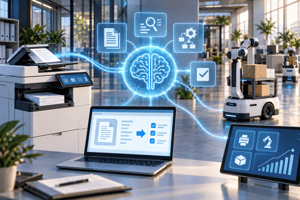
Imagine a workplace where a printer automatically requests supplies, an autonomous robot delivers them, an AI agent coordinates the activity, and a service platform monitors performance—all without requiring proprietary integrations between every component.
That is the vision behind these initiatives, and the conference's live robotics demonstrations were designed to bring that concept to life.
Equally important, open standards can help organizations avoid vendor lock-in while enabling manufacturers, developers, and service providers to innovate within a common ecosystem.
The Bigger Picture: From Transactions to Outcomes
Nathaniel Palmer's keynote, Robotics & Human-Centric Automation – From Transactions to Outcomes, captured perhaps the most important theme of the conference.
The future of automation isn't simply about replacing manual tasks with technology. It's about combining people, AI, software, and physical automation to achieve better business outcomes.
For office technology providers, this requires a different mindset. Rather than asking how many devices a customer needs, providers increasingly ask: What business problem are we solving, and how can intelligent automation deliver measurable improvements?
That's a much bigger opportunity.
Not Your Father's TWAIN Conference
TWAIN Converge 2026 represented more than an expanded conference agenda. It reflected an organization recognizing that the future of interoperability extends far beyond traditional document imaging.
AI is transforming information into intelligence. Automation is connecting decisions to actions. Robotics is bringing those capabilities into the physical workplace.
And open standards may be what allows all three to work together.
For manufacturers, dealers, developers, and technology providers, the message is clear: the next chapter of the office technology industry will not be defined solely by the devices we sell, but by the intelligent outcomes we enable.
TWAIN may have started by connecting scanners to computers. Its next chapter could be about connecting the entire intelligent workplace.
And that is definitely not your father's TWAIN conference.
Stay ahead in the ever-evolving print industry by browsing our Report Store for the latest insights. Log in to the InfoCenter to view research and studies through our Workplace- and Production-based Advisory Services. Log in to bliQ for product-level research, reports, and specs. Not a subscriber? Contact us for more information