

AI Solutions
AI-Powered Business Execution Platform

What print service providers need to begin their journey…into the future
Visit Keypoint Intelligence’s YouTube Channel for interviews and other insightful videos!
Most print service providers (PSPs) don’t start looking at robotics because they’re fascinated by automation. Rather, it’s because production friction keeps getting harder to manage. Bottlenecks disrupt workflow, manual handling slows throughput, and experienced labor is increasingly difficult to replace. Over time, these inefficiencies result in, among other things, lost productivity and operational instability.
That’s when robotics should enter the conversation.
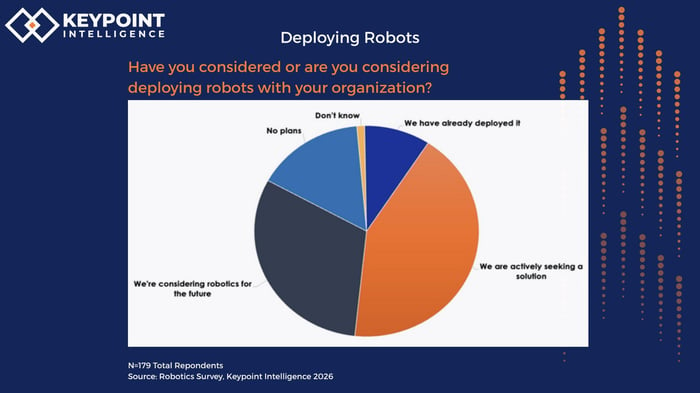
In a 2026 Keypoint Intelligence study, respondents were asked, “Have you or are you considering deploying robotics within your organization?” Although less than 10% are already using robots, nearly 75% were actively seeking a robotics solution or considering one for the future.
But the strongest automation projects rarely begin with the machine itself. There needs to be a clear understanding of where production repeatedly loses momentum. Based on what successful adopters are doing today, here are five practical considerations PSPs should evaluate before bringing robotics in-house.
1. Start with Workflow, Not Equipment
Too many automation discussions begin with vendor demonstrations instead of production analysis. The better approach? Identify where jobs consistently slow down, where manual handling creates delays, and where operators rely on workarounds to keep production moving. Robotics work best when it stabilizes an existing operational weakness.
2. Automate Repetitive Movement First
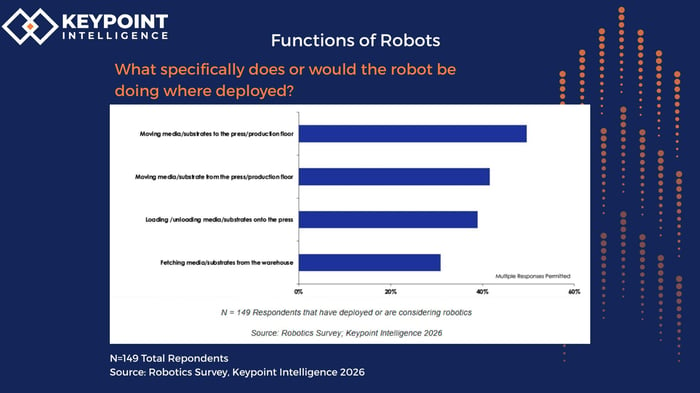
The easiest automation wins are often the least glamorous. Activities such as loading/unloading and repetitive material handling consume enormous amounts of time and, in our survey, the top planned functions centered on material movement. This matters because it shows that PSPs are using robotics to reduce operational drag and stabilize workflows instead of creating fully autonomous factories.
3. Understand the Cost of Inconsistency
A slow handling process affects far more than one workstation. Delays ripple outward into finishing, scheduling, overtime, idle press time, and missed delivery windows. Robotics often deliver its greatest value through production stability rather than raw speed.
4. Don’t Automate Broken Processes
Automation does not repair poor workflow design—in fact, it can accelerate the inefficiencies already present. If scheduling, staging, and communication remain inconsistent, robotics may simply relocate the bottleneck instead of eliminating it. Strong adopters simplify workflows before automating them.
5. Scale in a Controlled Deployment
Large-scale automation projects create operational strain quickly. PSPs seeing the smoothest transition tend to begin with one narrow process where success can be measured clearly. Incremental adoption can produce better long-term results than attempting to redesign the entire production floor at once.
The Bottom Line
Workflow discipline around print is as important as press technology. Robotics are becoming part of that equation as labor shortages, shorter turnaround expectations, and growing complexity continue pressuring PSPs.
Companies seeing the strongest results are approaching automation pragmatically. They solve operational friction one process at a time and integrate carefully, then they focus on consistency rather than chasing fully autonomous production.
Successful robotics adoption is not about the robot itself. Building a production environment that moves more efficiently and allows skilled employees to focus on the work that creates the most value.
And today’s economy being what it is: Value, like cash, is king.
Want five more things to help you on your path to robotics? Read the rest on WhatTheyThink.
Stay ahead in the ever-evolving print industry by browsing our Report Store for the latest insights. Log in to the InfoCenter to view research on robotics through our Production Workflow Software Advisory Service. Not a subscriber? Contact us for more information.
Keep Reading
Predictions That Are Reshaping Robotics in 2026


