

AI Solutions
AI-Powered Business Execution Platform
Early adopters are leading the charge
Sign up for The Key Point of View, our weekly newsletter of blogs, podcasts, and videos!
Not so long ago, artificial intelligence (AI) was primarily viewed as a distant-future disruptor in the production printing industry. It existed in trade show demonstrations and early-stage trials, but it wasn’t an integral part of real-world workflows. Over the past few years, however, AI has taken hold. The technology is everywhere, and it has impacted virtually every vertical industry in existence. Now, AI is moving beyond the experimentation phase and is making its way into actual deployments. This is especially the case among larger, technology-forward print service providers (PSPs).
Despite its far-reaching impact, AI isn’t affecting our industry in quite the way that many expected. Instead of completely revolutionizing the print production process, AI is facilitating incremental progress. Businesses are leveraging AI to optimize their workflows, make better decisions, and manage the complexity of modern print production.
Interest in AI is expanding, largely because of ongoing structural changes that are taking place in the production printing landscape. Modern PSPs are facing increased pressure to get more done with fewer resources. Customers are demanding shorter print runs, increased job variability, faster turnaround times, and a greater degree of customization.
Traditional workflow systems were designed to handle long runs and repeatability, so they aren’t well-suited for this new reality. AI offers a solution because it helps print providers meet the evolving needs of today’s customers. Since it’s capable of analyzing large volumes of production data, AI can make smart predictions, automate routine decision-making, and create more optimized workflows. These capabilities are particularly valuable in hybrid print production environments where digital and analog processes are used together.
AI is undoubtedly making its presence known, but it is still in its early adoption phase. Most implementations are occurring in workflow and production management rather than on the press itself. Some of the most common areas for AI deployment include scheduling optimization, automated estimating, and production planning. Organizations are primarily integrating AI into their existing workflows to reduce the need for technical expertise and lower the risk of implementation.
According to Keypoint Intelligence’s most recent Global Software Investment Outlook, AI is most commonly used for graphic design, image quality, and customer service. All these uses can be considered general capabilities that benefit the production process.
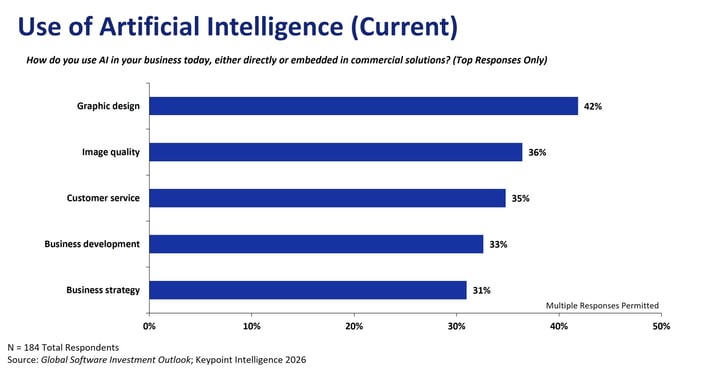
Only 8% of this year’s survey respondents weren’t using AI at all, which is down from 12% in our 2025 survey.
Current use is about efficiency. Survey participants are turning to AI to expand data analysis and optimization rather than attempting to achieve completely autonomous production. At least for now, AI is being used to enhance familiar systems instead of replacing existing processes.
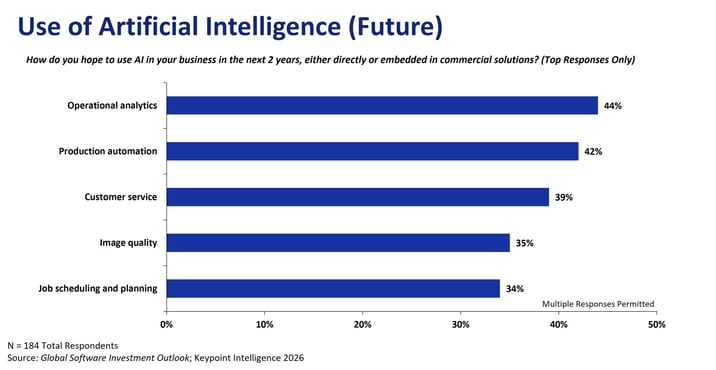
Future implementation plans suggest that AI will be used more strategically to better support the decision-making process. As shown in the Figure below, the focus is expected to shift toward more production-specific capabilities like production automation, operational analytics, and job scheduling/planning.
Even the small share of businesses that haven’t yet implemented AI are actively exploring it. The question is no longer whether AI is worth the investment; It’s determining the areas where AI can be used so it delivers the most value. Meanwhile, early adopters are expanding their investments and implementing AI across a broader range of functions. We’re seeing a transition from experimentation to strategic deployment and integration, and this proves that AI is becoming a core consideration for the industry.
AI makes it easier to unlock the value of data, and this is one of its biggest benefits to production printing. Printing environments have massive amounts of important information, but much of this data has historically been underutilized. By transforming raw data into actionable insight, AI can help identify trends, suggest changes, and anticipate issues before they occur.
Predictive maintenance is just one example of how AI can strengthen Because it can analyze equipment performance and flag potential failures, downtime can be reduced even as productivity increases. Similarly, AI-driven quality control can uncover inconsistencies early on, minimizing waste and improving output consistency.
In addition, AI’s role in automation is evolving. AI-enabled systems can perform intelligent file preparation, workflow routing, and color management with minimal human intervention. These tools are good news for human workers because they alleviate the burden of repetitive, data-intensive processes. As a result, employees have more time to focus on higher-value activities.
Keypoint Intelligence’s research further confirms that AI is also having an effect on robotics. While still in its early stages, we are seeing a growing interest in using robotics for tasks like material handling and finishing. Today’s robotics deployments are largely focused on moving media and substrates around the production floor or loading/unloading. Because these tasks are repetitive yet labor-intensive, they are prime candidates for the automation that robots can offer.
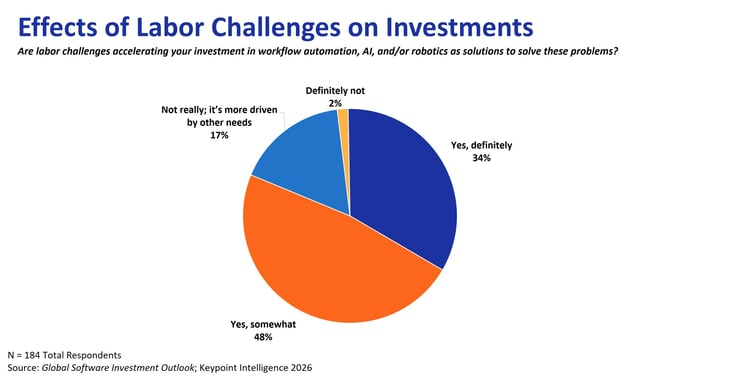
AI can enhance robotics systems by making them more adaptive and responsive. This might eventually pave the way for more collaborative environments where robots and human operators work side by side. This trend is closely related to one of the print industry’s most persistent challenges: labor shortages. As experienced workers retire and fewer new entrants join the field, PSPs are struggling to maintain staffing levels. AI-enabled automation and robotics offer a way to sustain productivity while reducing reliance on specialized labor. It is therefore unsurprising that over 80% of respondents to our research report that ongoing labor challenges are accelerating their investment in workflow automation, AI, and/or robotics in some regard.
The interest in AI is strong and growing, but adoption is far from uniform. Larger firms with more resources and technical expertise are leading the charge, while smaller PSPs are behaving more cautiously. Integration with legacy systems is often complicated, and many businesses lack the expertise to implement AI effectively. There are also concerns with return on investment and data readiness. Some organizations lack the high-quality, well-structured data that AI systems rely on. As a result, many PSPs recognize the potential of AI but are unsure how to get started.
At this stage, AI in production printing is more foundational than transformational. We’re not seeing fully autonomous print environments or radical changes to the production process. The focus is on smaller enhancements like better scheduling, smarter planning, improved analytics, and more efficient automation. Rather than completely revolutionizing the production printing process, AI is steadily reshaping how our industry operates. The most successful PSPs will likely be those that align AI initiatives with business goals, integrate them into existing workflows, and learn to make better use of their data. Vendors can also play a role by embedding AI into familiar platforms and lowering the barriers to entry.
Stay ahead in the ever-evolving print industry by browsing our Report Store for the latest insights. Log in to the InfoCenter to view research and studies through our Workplace- and Production-based Advisory Services. Log in to bliQ for product-level research, reports, and specs. Not a subscriber? Contact us for more information.