

AI Solutions
AI-Powered Business Execution Platform
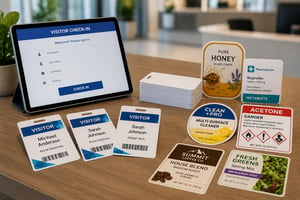
Epson adds a lower-cost, dye-ink model to ColorWorks lineup, targeting buyers the pigment-ink line wasn't reaching
Sign up for The Key Point of View, our weekly newsletter of blogs, podcasts, and videos!
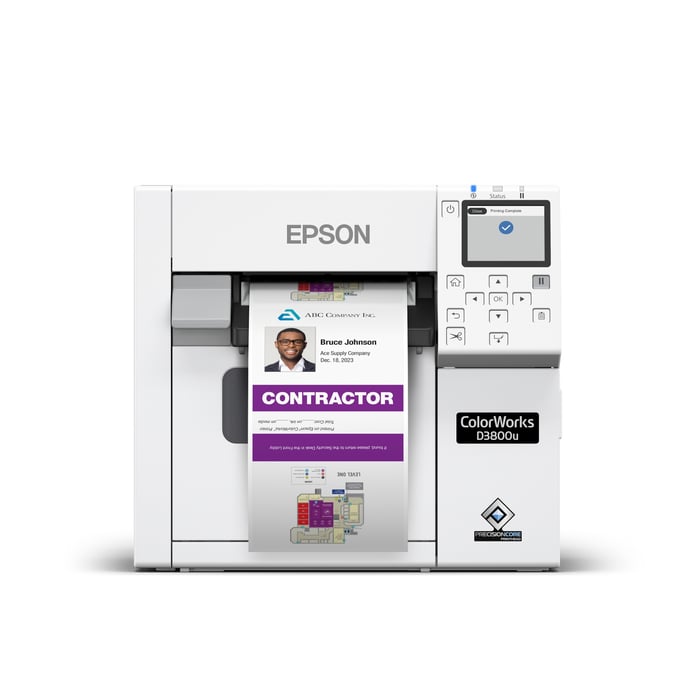
Epson has introduced the ColorWorks CW-D3800, a compact color label and badge printer that slots in below the existing CW-C4000 in the ColorWorks lineup. The new model shares the same footprint and general form factor as the CW-C4000, but it is not a simple rebrand. Epson has built it around dye-based ink rather than the pigment ink used across the rest of the ColorWorks family, a change that reshapes both its cost structure and its recommended use cases.

Inside the CW-D3800
The CW-D3800 is built on Epson's PrecisionCore Heat-Free print head technology, the same architecture used across ColorWorks, with a print head engineered to last the life of the device rather than function as a consumable. It supports Epson's ESC/Label language as well as Zebra's ZPL II, runs across major operating systems, and includes an optional Wi-Fi dongle along with Epson Device Admin for remote fleet monitoring. The specifications point to a printer built for standard label stock and cut labels, a fit for the shorter, lower-volume runs the CW-D3800 targets, roughly under 50 labels or badges per day by Epson's own guidance, rather than the high-gloss or continuous-roll jobs suited to the CW-C4000. Epson has also excluded continuous-roll label support on the CW-D3800 due to a simpler auto-cutter design than the CW-C4000's, and ink capacity is lower as well, 40 mL versus 50 mL, a design choice specifically intended for market segments with lower print volumes. That focus comes with a lower hardware cost paired with a higher consumable cost.
Positioning the CW-D3800
Epson describes the move as an effort to reach a segment it has not been serving directly, low-volume users with entry-level budgets who are currently either buying pre-printed labels through a two-step process or using a competitor's color label printer. Epson frames the choice of dye ink as deliberate, not a cost-cutting shortcut. The company points to dye ink's resistance to dry scratching and its more saturated blacks, browns, and grays compared with pigment ink as an advantage for shorter-term applications like single-day visitor badges, where the water and UV resistance of pigment ink isn't a requirement. That positioning leaves the CW-C4000, CW-C6000, CW-C6500, and CW-C8000 pigment-ink models as Epson's recommended fit for multi-day event badges, GHS chemical labeling, pharmacy applications, and more where longer-term durability matters more. Within the color label printer landscape, Epson notes the total cost of ownership benefits of its individual-color cartridges. In contrast to designs that use tri-color cartridges, where replacing the entire cartridge is required when one color is depleted, the CW-D3800 allows users to replace only the color that has run out.
Epson is pairing the hardware launch with an expanded software lineup. The shipping-label tool previously known as Label Boost has been renamed Label Boost Shipper, and Epson has built two additional tools under the same name. Label Boost Designer is a free label design application for Mac and PC, letting buyers create and format their own label templates without a separate design tool, a good fit for CW-D3800 buyers who may not have an existing design workflow. Label Boost Concierge is a companion mobile app built for kiosk-style visitor and event badge check-in, letting front-desk or event staff capture visitor information and trigger a badge print directly from the app rather than through a separate check-in system. Neither tool had shipped as of this writing. Designer is expected shortly, with Concierge following in the next couple of months.
Keypoint Intelligence Opinion
The dye-versus-pigment distinction is a practical way to segment the ColorWorks line without cannibalizing the higher-durability models, and it maps to a real gap in how these devices get used. Visitor badges, small-batch labeling, and similar short-term applications don't require the water and UV resistance that pigment ink provides, and buyers in that segment have often had to pay for durability they didn't need or settle for monochrome and thermal alternatives instead. The CW-D3800 gives them a purpose-built option at a lower entry price, and the free software bundle, once both pieces ship, removes a common friction point for less technical buyers who might otherwise need to source and license a separate design tool.
Epson's channel strategy extends the CW-D3800's reach to IT, operations, or security buyers managing visitor programs who wouldn't otherwise see the product through Epson's existing label and print channel. That approach reflects a good read of where the buying decision for visitor management actually sits, often outside the print or label function altogether, and it places the CW-D3800 in consideration alongside the security and visitor management systems it will need to integrate with, rather than as a standalone print purchase. That said, the dye-versus-pigment distinction places real responsibility on resellers to communicate the tradeoff clearly at the point of sale. A buyer who doesn't understand why a CW-D3800 badge won't hold up the way a CW-C4000 badge would is a support and satisfaction risk down the line.
Stay ahead in the ever-evolving print industry by browsing our Report Store for the latest insights. Log in to the InfoCenter to view research and studies through our Workplace- and Production-based Advisory Services. Log in to bliQ for product-level research, reports, and specs. Not a subscriber? Contact us for more information.