

AI Solutions
AI-Powered Business Execution Platform

Resetting the mail industry one piece at a time
Sign up for The Key Point of View, our weekly newsletter of blogs, podcasts, and videos!
On April 8th, BlueCrest hosted its client summit at its headquarters in Danbury, Connecticut—bringing together employees, partners, customers, and analysts. The audience represented a meaningful portion of the US mailing ecosystem that spans technology providers, service providers, and major mailers. The event featured perspectives from BlueCrest leadership (including CEO Kim Anderson and CMO Kevin O’Connor) alongside a keynote and discussion with Postmaster General of the United States Postal Service (USPS) David Steiner. Additional sessions focused on technology, operations, service, and the path forward.
Across the day, one message stood out: The conversation is no longer about preserving the past—it is about redefining the future role of mail.

Redefining the Role of Mail
The US mailing ecosystem remains one of the largest in the world with billions of pieces processed annually. However, long-term contraction is well understood with volumes roughly halving over the past two decades.
Rather than focusing on reversing that trend, speakers consistently emphasized a different priority: repositioning mail within a changing communications landscape. That repositioning centers on increasing relevance; improving engagement; and integrating mail into broader, multi-channel strategies. Mail is no longer being defended against digital alternatives—instead, it is being reframed as a complementary channel with a distinct role.
What Is Driving This Shift?
Several forces are accelerating change across the ecosystem.
Postmaster General David Steiner outlined the financial and operational pressures facing the USPS, including ongoing volume contraction and structural limitations. As he noted, “The reality is the current system is not sustainable… we have to make changes to ensure long-term viability.” These realities are forcing broader discussions about how the system must adapt.
At the same time, digital transformation continues to reshape customer expectations. Rather than replacing print, it has created a more complex communications environment where each channel must clearly demonstrate its value.
Technology is also playing a more central role. Sessions led by BlueCrest executives (including VP Global Product of Mail Production Solutions Eddy Edel) highlighted how automation, data, and artificial intelligence (AI) are enabling more efficient and flexible production environments. Edel pointed to the convergence of direct mail and transactional workflows that is driven by shared platforms and technologies.
A consistent theme throughout the event was the need for stronger alignment across the ecosystem. Siloed approaches—across vendors, service providers, and the postal network—are increasingly limiting the industry’s ability to respond effectively.

Reinforcing the Role of Print in a Digital-Heavy World
During the event, BlueCrest CMO Kevin O’Connor referenced research from Keypoint Intelligence that reinforces how print is evolving within modern communication strategies.
Four themes stood out:
Together, these findings point to a broader shift. Print is no longer treated as a standalone channel, but a part of a coordinated strategy designed to drive measurable outcomes.
On the Production Floor
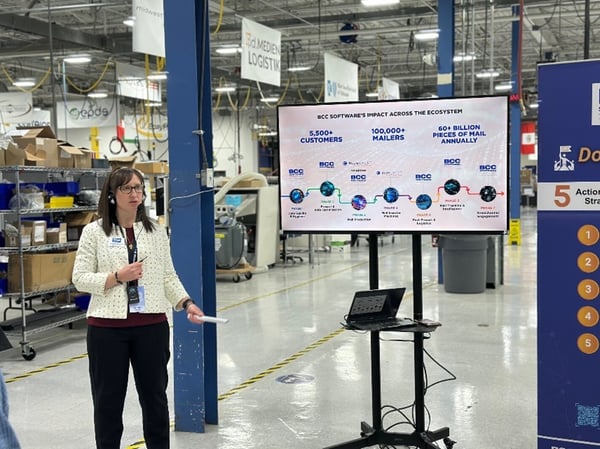
In addition to the presentations, attendees toured BlueCrest’s production floor, where technologies were demonstrated across print, inserting, sortation, and software environments. The tour provided a practical view of how the themes discussed throughout the event are being applied in production settings. Demonstrations included integrated solutions supporting vote-by-mail processing as well as workcell automation technologies designed to reduce manual intervention and improve operational performance.
One example was BlueCrest’s OttoMate, a robotic solution designed to automate repetitive tasks within the inserter workcell. The demonstration highlighted how automation is being applied to address labor constraints while improving consistency and throughput.
Software also played a visible role. BlueCrest’s BCC software was showcased as part of the workflow, supporting address quality, data management, and postal optimization. This reinforced the importance of data integrity and compliance as foundational elements of modern mail operations.
Overall, the tour highlighted a shift toward more connected workflows, increased automation, and a stronger emphasis on visibility, tracking, and compliance.
What This Means for the Market
The implications of these shifts are already taking shape. Organizations are increasingly adopting hybrid communication models that integrate print and digital to improve engagement and response rates. Direct mail is becoming more targeted and data-driven, while transactional communications are being repositioned as strategic touchpoints that can enhance customer experience and drive additional value.
At the same time, production environments are becoming more intelligent. Data is playing a larger role in decision-making, workflows are becoming more automated, and operations are evolving to be more flexible and adaptive.
Keypoint Intelligence Opinion
The discussions at the BlueCrest Summit reinforce a broader shift across the print and document solutions market. The future of mail will not be defined by a return to historical norms. It will be shaped by how effectively the industry adapts to a changing communications landscape. Mail continues to offer distinct advantages—particularly in trust and engagement, but its role is evolving. Success will increasingly depend on how well organizations integrate print into broader strategies, measure outcomes beyond volume, and leverage technology to improve performance.
The message from the summit was clear, standing still is not a viable path forward. As mail volumes shift, the industry must redefine its role and not retreat from it.
Stay ahead in the ever-evolving print industry by browsing our Report Store for the latest insights. Log in to the InfoCenter to view research and studies through our Workplace- and Production-based Advisory Services. Log in to bliQ for product-level research, reports, and specs. Not a subscriber? Contact us for more information.