

AI Solutions
AI-Powered Business Execution Platform

Discussions on AI that actually deliver
Sign up for The Key Point of View, our weekly newsletter of blogs, podcasts, and videos!
On April 16th, Tungsten Automation held their Summit in New York City—one of many stops for them around the globe. From the get-go, “change” was the keyword of the day…particularly for change driven by artificial intelligence (AI) in business. However, Tungsten didn't treat the term as a buzzword. Hosted by Senior VP of Sales Gopi Kalahasthy, with CEO Peter Hantman offering welcoming remarks, the summit centered on a more practical question: “How does Tungsten intend to turn AI into something usable, governed, and scalable for customers?”
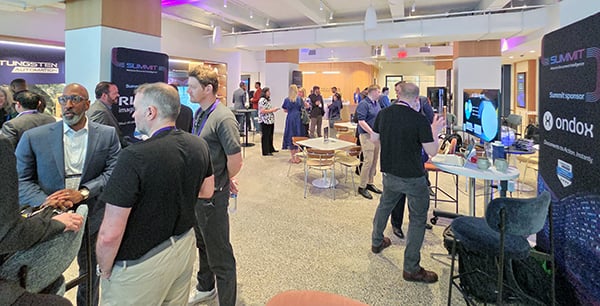
Customers viewing demos and catching up with colleagues
before the afternoon sessions start
Rather than presenting AI as a category unto itself, Tungsten positioned it as an added layer across document intelligence, workflow automation, accounts payable/accounts receivable (AP/AR) modernization, and payments. The discussion kept coming back to the same ideas of making unstructured data usable, applying AI where it can improve actual processes, and tying it all back to measurable business value.
The Speakers and the Takeaways
CSO & EUP of Marketing Tamas Hevizi helped set the tone by describing attendees as “changemakers” (ah, already back to that word “change”). He argued that successful AI transformation depends on four things: choosing the right business problem, identifying the right data, selecting the right AI, and working with the right partner. Simple as that sounds, his point was that many AI projects stall because enterprises try to apply models before figuring out how to operationalize their own data, business rules, and compliance requirements. He also stressed that unstructured information remains one of the biggest barriers to enterprise AI, particularly when businesses need to move it into downstream workflows.
Bouncing off that idea, one of Hevizi’s more useful points was that customers should not assume the answer is pure GenAI everywhere. Instead, he argued for a hybrid model that blends traditional AI and generative AI with deterministic technologies handling predictable, high-volume work and newer models stepping in where ambiguity, reasoning, and exceptions come into play. That idea carried through the rest of the event: Tungsten is not positioning AI as a replacement for its automation foundation, but to make that foundation smarter and more flexible.
Adam Field followed with “Keep Calm and AI On,” a session aimed at cutting through AI hype. He touched on the fear, inflated expectations, and “SaaSapocalypse” rhetoric surrounding the market, but his main point was more practical in that enterprise value comes from a mix of strong technology, domain know-how, and risk transfer. Customers are not just buying software; they are buying a way to reduce complexity and take risk out of critical business processes.
Field sharpened that point through the idea of “boring AI,” meaning the non-glamorous but mission-critical processes businesses still need to execute accurately and at scale. The real opportunity, in his view, is not in flashy experiments, but in solving hard operational problems like compliant e-invoicing, banking workflows, and logistics documentation. One of his more relevant product points was that enterprise AI cannot be left unmanaged. He emphasized wrapping autonomous systems in deterministic processes, so agents operate inside structured, auditable, and controlled environments.
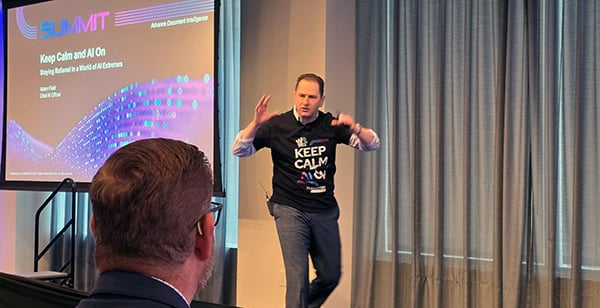
“Keep Calm and AI On” with Adam Field
Field’s discussion with Arpad Hevizi, Qualcomm’s VP of Digital Value Creation, added a useful customer perspective towards the end of his session. Arpad argued that businesses should stop measuring AI only in terms of labor savings and, instead, think in terms of decision and process velocity. He also warned against rewarding “demo theater” over real transformation. His comments reinforced the broader summit message that AI truly matters when it changes how the business operates.
Danielle Weinblatt then brought the discussion squarely into product strategy with “Product Vision & Roadmap Overview: Giving You the Foundation to Scale.” This was one of the strongest sessions of the day for understanding how Tungsten is trying to position itself. Weinblatt’s core message was that enterprise information is still trapped in unstructured content, and AI is only useful when that information can be turned into trusted, compliant, AI-ready data. She outlined Tungsten’s four-layer foundation—ingestion, understanding, knowledge, and orchestration—and made clear that the company wants to move beyond simple extraction toward a broader role that includes validation, context, business rules, and downstream workflow execution.
Weinblatt tied that vision directly to the portfolio. TotalAgility remains the anchor for document and workflow automation, InvoiceAgility continues to drive AP and AR automation, and Power PDF is gaining more GenAI functionality (including copilots and AI-assisted redaction). She also noted that AI adoption is already growing across the product line with increased use of extraction copilots, agentic processes in TotalAgility, and AI features in Power PDF. Essentially, Tungsten building these capabilities into products customers are using now. She also spent significant time on Pay+, Tungsten’s new embedded business-to-business (B2B) payments capability, which was presented not as a side product but as a natural extension of invoice intelligence once invoice data becomes trusted and context-rich.
Jonathan Darbey built on these ideas in “Beyond IDP: From Documents to Decisions - And the Role of Agents.” His main argument was that the industry has spent too much time optimizing extraction when the real value comes from completing transactions. He spent his time shifting the conversation away from extracting data better and toward executing end-to-end transactions more intelligently through reconciliation, risk and compliance checks, approvals, and payments. Rather than describing agents as generic assistants, he framed them as domain-specific components designed to manage intake, document understanding, risk evaluation, decision logic, payment execution, and archiving inside structured enterprise workflows. He tied that directly back to TotalAgility, positioning it as the platform that enables documents-to-decisions-to-action.
Emily Nash-Walker closed the speaker sequence by bringing the conversation directly into the office of the CFO with “Invoice Automation Strategy to Business Success: Compliant AP & AR with Agents.” Rather than focusing only on tactical AP metrics, she framed InvoiceAgility as part of a broader cash flow management strategy. Her point was that AP/AR modernization should support liquidity, supplier resiliency, fraud prevention, and compliance just as much as operational efficiency.
Nash-Walker also emphasized the person in the loop. In finance workflows, she argued, AI outputs still need oversight, validation, and accountability—especially as compliance requirements continue to expand globally. She described InvoiceAgility as a platform that can process invoices across countries while helping customers bring efficiency and compliance into a single business process, rather than relying on fragmented regional workarounds. Her discussion of embedded payments extended that point: Once invoice data is understood and validated, payments can become more dynamic, more traceable, and more useful for optimizing working capital and supplier relationships.
Keypoint Intelligence Opinion
This was not a summit built around buzzwords with vague transformation language. Instead, the company repeatedly anchored its vision in TotalAgility, InvoiceAgility, PowerPDF, and Pay+, while using Doc AI as the umbrella concept that connects them.
The bigger story is that Tungsten is trying to move beyond classic IDP and play a larger role in day-to-day business operations. Trusted AI-ready data, workflow orchestration, finance automation, and embedded payments now appear to sit within the same product direction. Never did Tungsten claim that AI changes everything overnight. Rather, Tungsten’s message was that AI should be applied where it can make enterprise workflows faster, more accurate, and more actionable without stripping away the governance those workflows still require. Now, it’s up to the changemakers to take action and leverage simple and advanced AI alike to their advantage.
Stay ahead in the ever-evolving print industry by browsing our Report Store for the latest insights. Log in to the InfoCenter to view research and studies through our Workplace- and Production-based Advisory Services. Log in to bliQ for product-level research, reports, and specs. Not a subscriber? Contact us for more information.