

AI Solutions
AI-Powered Business Execution Platform

How print embellishments can capture attention, elevate experiences, and deliver greater value
Sign up for The Key Point of View newsletter for more blogs, podcasts, and videos!
For marketers, print buyers, and print service providers, embellishments are often considered just a finishing touch that occurs after the actual printing work is complete. When used strategically, however, these foils, varnishes, textures, coatings, or dimensional effects are much more than decorations. They can make printed communications perform better by attracting attention and encouraging consumers to act.
In an environment where countless marketers are competing to reach the same customers, brands need eye-catching printed pieces that quickly communicate value and create unique experiences that digital channels can’t easily replicate. Cost control is important, so embellishing everything isn’t the answer. Instead, brands should work to identify moments when tactile or visual finishing can make a difference, and then invest accordingly. Print businesses that make the most of embellishments can develop communications that really get noticed.
Taking a Disciplined Approach
With print embellishments, it’s unfortunately very easy to get lost in the technology. Rather than haphazardly applying foils, varnishes, or raised textures, however, it’s wise to take a step back and first consider the desired response. Before deciding how—or even if—a piece should be embellished, print businesses should first determine what they want the recipient to notice, feel, or do differently based on that embellishment. For example:
A luxury retailer might use foils or metallics in its packaging or direct mail to reinforce feelings of higher value and exclusivity.
A college or university might use dimensional effects to make a prospective student’s acceptance package feel more substantial and significant.
A financial firm may apply specialty printing effects to distinguish its high-value customer communications from its everyday transactional mail.
Because specialty printing already represents a considerable share of print budgets, a disciplined approach is necessary. According to recent research from Keypoint Intelligence, survey respondents allocated an average of 18% of their current print spend to specialty printing techniques (identified as personalization, embellishments, specialty substrates, QR codes, and/or specialized finishing).
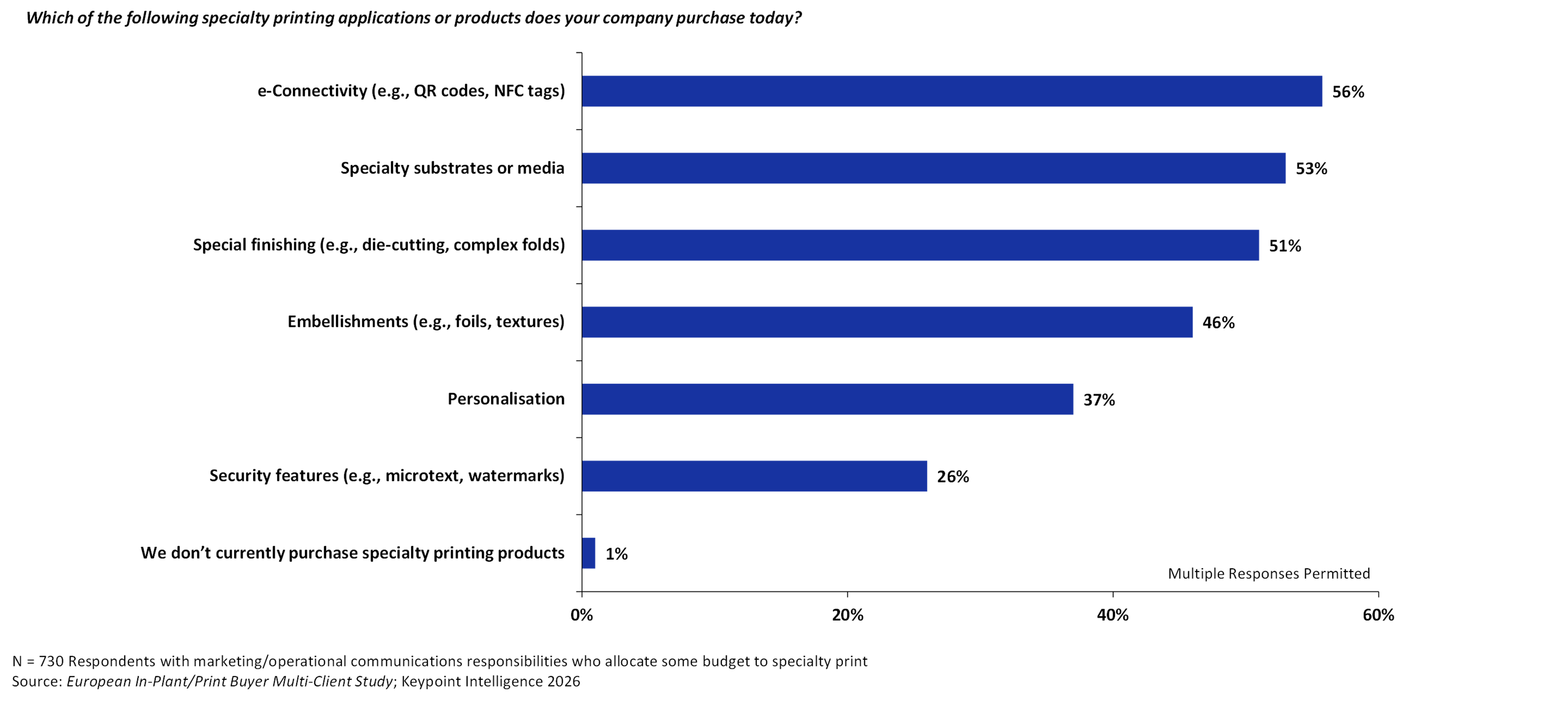
In addition, specialty treatments are truly taking hold in today’s marketplace. Among firms that are currently allocating some of their budgets to specialty print, 46% purchase embellishments (e.g., foils, varnishes, textures). Meanwhile, over half purchase special finishing (e.g., die-cutting, soft-touch coatings, complex folds) or specialty substrates/media.
Figure 1: Specialty Printing Applications Purchased
There’s no question that specialty printing can make a difference. The key is determining how and where to use it to make the greatest impact.
Investing the Right Way
In addition to being prohibitively expensive, using specialty printing too often diminishes its effect. For this reason, printers should categorize their applications based on strategic importance. Everyday communications probably don’t need embellishments, but product launches, loyalty programs, or special events might. It’s also important not to go overboard, because using restraint can increase the effectiveness of a printed communication. It’s one thing to selectively highlight a logo, feature, offer, or call-to-action, but it’s quite another to overembellish the entire communication. If everything shines, nothing stands out.
Embellishments are an investment, so they need a strong value proposition that is tied to an important business outcome. PSPs must help their customers move away from conversations about cost per piece alone. The real question is what the additional investment can potentially accomplish.
Communicating Value
Keypoint Intelligence’s print buyer research confirms that marketers recognize this capability. A strong majority of respondents (89%) somewhat or strongly agreed that print will remain important because it captures attention and promotes a premium brand experience. Print providers have an opportunity to position embellishments as part of brand strategy rather than simply an additional production option. The most productive conversations will likely connect specific treatments with specific objectives. Specifically:
Simply put, any specialty treatment should reinforce a brand’s promises.
Pairing with Personalization for Greater Impact
Print embellishments become even more powerful when paired with personalization. Print buyer survey respondents report that on average, nearly 20% of their existing print jobs contain personalization beyond a recipient’s name and address. Even more importantly, 70% of businesses that are already using personalized print expect their use to increase over the next 3 years.
Personalization communicates relevance, but embellishments command attention. When used together, these two aspects can take printed pieces to the next level. Companies should explore how design, imagery, offers, and specialty treatments can be aligned with customer value or campaign purpose. For example, businesses can consider creating two versions of a piece based on the same creative platform. The most important prospects might receive something highly differentiated with embellishments, while others receive a basic version of the same communication. A tiered production approach can keep embellishments economically practical because the investments are concentrated where they are most likely to influence behavior.
Using Print to Prioritize the Digital Connection
Because print plays well with digital channels, it should come as no surprise that 86% of respondents to our print buyer survey are already integrating print and digital campaigns. Of these, about 73% expect print’s role in multi-channel campaigns to increase over the next 3 years.
This points to another valuable application for embellishments: Drawing attention to the mechanism that connects a physical piece with a digital experience. An embellished call-to-action surrounding a QR code, pURL, or NFC interaction can visually and physically direct the recipient toward the next desired step. This type of connected design uses a printed piece to actively prioritize the digital connection.
As is the case with personalization, PSPs should think about ways that they can use connectivity with embellishments. Any embellishments will attract attention, and connectivity can convert that attention into a measurable interaction.
Taking Advantage of the Opportunity
Despite ongoing cost pressures, savvy businesses are not shying away from using embellishments when it makes sense. About 63% of respondents to Keypoint Intelligence’s research expected the share of their print spending devoted to specialty applications to increase over the next 3 years. Meanwhile, only about 10% anticipated a decrease.
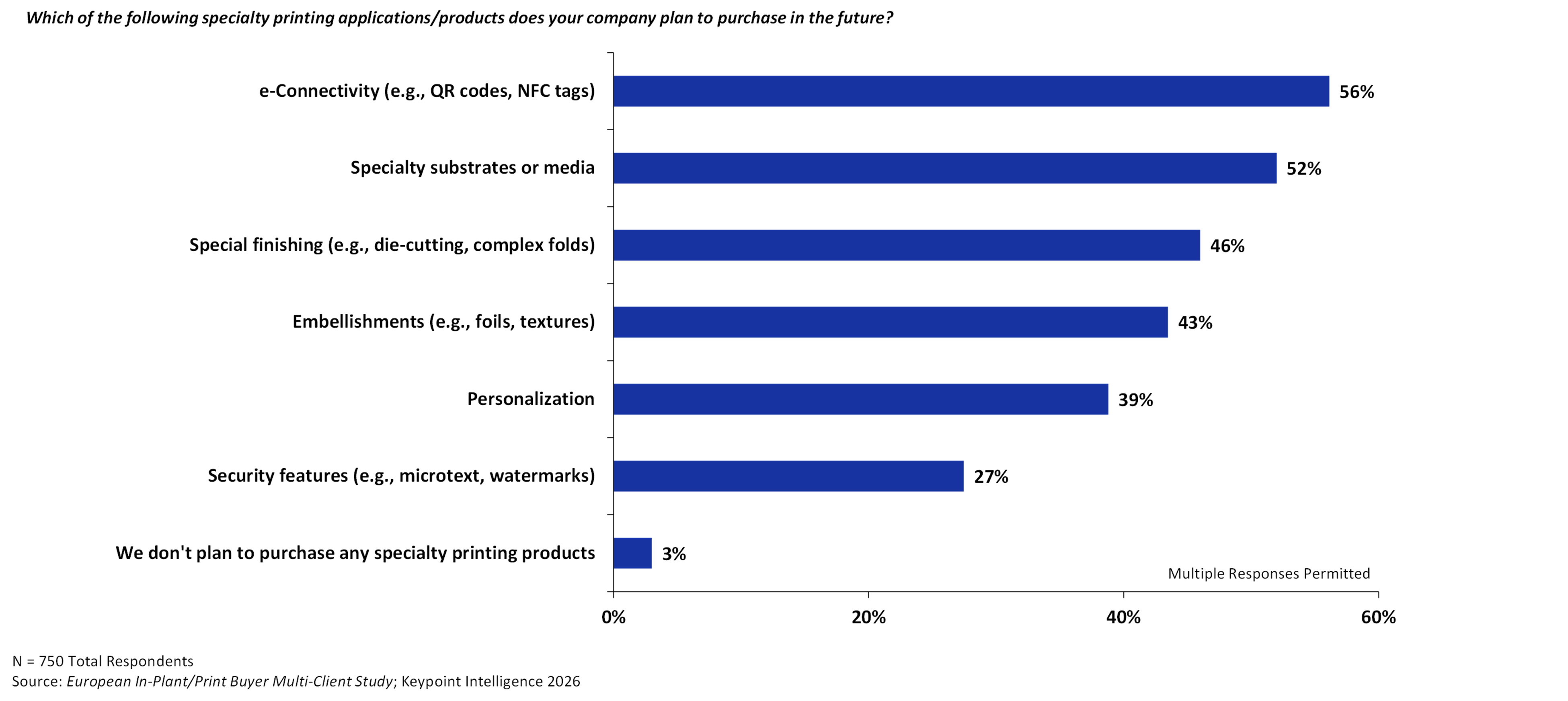
Future purchasing intentions tell a similar story. Over half of respondents plan to purchase specialty substrates, and another 46% expect to use special finishing techniques. Additionally, 44% of respondents expect to purchase printed embellishments like foils, varnishes, or textures.
Figure 2: Future Purchasing Plans for Specialty Print
The Bottom Line
The print embellishment opportunity is clear, but capturing it involves more than installing equipment or expanding a finishing menu. PSPs must help customers determine where specialty treatments fit into their overall communications strategy. They can offer prototypes that enable firms to experience treatments before approving production, develop better options at different budget levels, and recommend targeted embellishments. For their part, buyers shouldn’t treat finishing decisions as the final production step. Designers, marketers, print specialists, and production teams should discuss embellishments at the outset so the format, substrate, imagery, data, finishing, and response mechanisms can all work together.
Physical differentiation still has value in a digital-first world. The winning applications will use foils, textures, coatings, or elaborate finishing deliberately, where and when it makes the most sense. Embellishments go far beyond mere decorations when they command attention, reinforce a brand’s promise, elevate an important moment, encourage interaction, or otherwise make the recipient feel that the communication was worth noticing.
Learn more about the enduring power of print by browsing our Report Store for the latest insights. Log in to the InfoCenter to view ongoing research from our Production Print Advisory Services. If you’re not already a subscriber, please contact us for more information.