

AI Solutions
AI-Powered Business Execution Platform

War, demographics, and the economic pressure points shaping global markets
Sign up for The Key Point of View, our weekly newsletter of blogs, podcasts, and videos!
War rarely stays contained in the regions where it begins, and macroeconomic shifts rarely come from a single source. In today’s interconnected economy, conflict sends ripple-effects through supply chains, energy markets, and national budgets in ways that are difficult to isolate (and even harder to predict). The latest reporting and global analysis surrounding tensions involving Iran and the broader Middle East reinforces just how far-reaching those impacts can be.
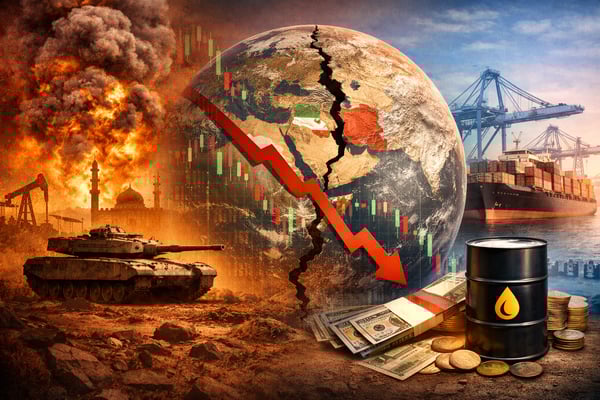
The Impacts of War Span Further Than Warzones
The economic impact of war tends to show up quickly. Energy markets are often the first signal. Disruptions to oil and gas flows, particularly through critical routes like the Strait of Hormuz, have already pushed prices higher and introduced volatility across global markets. In parts of Africa, for example, rising commodity prices are amplifying existing economic vulnerabilities tied to import dependence and supply chain exposure.
At the same time, developed economies are preparing for longer-term implications. Japan has warned that extended instability tied to conflict involving Iran could affect trade flows, energy access, and broader economic stability.
Long-Term Financial Impact
Energy markets remain one of the most sensitive indicators of geopolitical tension. The Middle East plays a central role in global oil production, so even the perception of risk can cause price volatility. When energy prices rise, the impact cascades across industries ranging from manufacturing to transportation, ultimately affecting everything from consumer goods to operational costs. This creates a scenario where businesses must navigate not only higher expenses, but also greater uncertainty in forecasting and planning.
Beyond immediate disruptions, the long-term financial cost of conflict is substantial. Global estimates suggest that wars in the Middle East can generate economic burdens that extend far beyond military spending. These costs include rebuilding infrastructure, lost productivity, displaced populations, and prolonged instability that discourages investment.

Businesses and Governments Shift Priority
Another important factor is how businesses and governments respond to uncertainty. In periods of instability, organizations tend to shift priorities toward cost control, risk mitigation, and operational efficiency. This often accelerates investments in automation, supply chain diversification, and digital transformation as companies look for ways to reduce exposure to external shocks. At the same time, global trade patterns can begin to shift. Companies may seek alternative sourcing strategies or relocate production to reduce dependency on volatile regions. While this can create new opportunities in some markets, it also introduces complexity and transitional costs that can take years to stabilize.
Layered onto this is a separate, non-war-related pressure that continues to build: an aging global population. While less immediate than geopolitical disruption, its impact is just as significant. As birth rates decline and life expectancy increases, the available workforce shrinks—leading to limited productivity, slow economic growth, as well as increased demand for healthcare and pension support.
When these forces overlap, the economic environment becomes more difficult to navigate. War creates short-term shocks through energy and trade disruption, while demographic change reduces how quickly economies can recover or adapt. Businesses are left managing higher costs while labor markets tighten and growth slows.
In response, organizations are adjusting their strategies. Supply chain diversification, automation, and digital transformation are becoming more central as companies work to build resilience. Governments face a similar balancing act, managing short-term economic stability while addressing long-term structural challenges tied to demographic change.
Keypoint Intelligence Opinion
From a macroeconomic standpoint, the current environment is less about a single disruption and more about overlapping constraints. Conflict-driven volatility and demographic shifts are contributing to a more cautious, efficiency-focused global economy. For the document solutions and office technology space, this reinforces a familiar direction: Organizations are investing in automation, streamlining workflows, and prioritizing cost visibility.
These are not just efficiency plays. They are responses to a broader environment where unpredictability is becoming the baseline. The underlying conditions may differ, but the outcome is consistent. Businesses are building systems designed to absorb disruption, not react to it.
Stay ahead in the ever-evolving print industry by browsing our Industry Reports page for the latest insights. Log in to the InfoCenter to view research and studies through our Workplace- and Production-based Advisory Services. Log in to bliQ for product-level research, reports, and specs. Not a subscriber? Contact us for more information.