

AI Solutions
AI-Powered Business Execution Platform

Pressure mounts across the value chain, but industry response is more strategic than reactive
Check out Keypoint Intelligence’s On Demand Printing & Publishing Services!
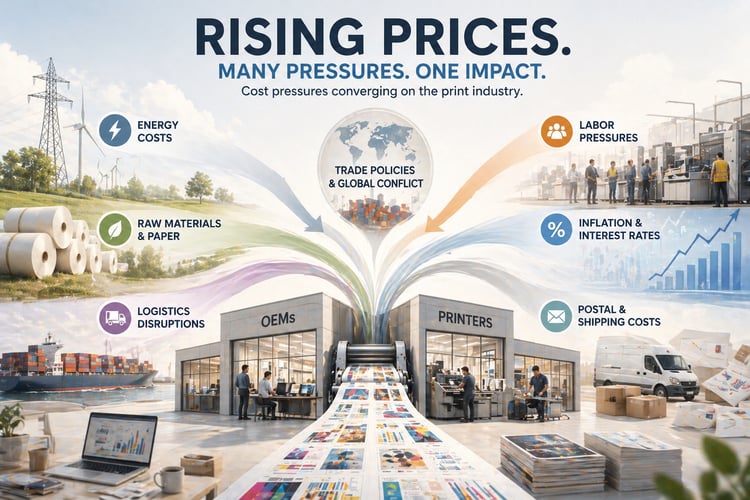
Cost pressures are nothing new to most industries, including the print industry. What is different now is their persistence and and their increasing overlap. Energy, supplies, logistics, labor, postal fees, and tariffs are no longer moving in isolation. They are compounding.
So, what does this mean in practice?
Here are five things the industry needs to understand and act on.
1. Cost Pressures Are Compounding, Not Cycling
Over the past few years, print service providers (PSPs) have faced sustained increases across nearly every major input cost category. Paper remains the most visible pressure point, but it is far from the only one.
Energy volatility, particularly in Europe, continues to reshape the economics of paper production. At the same time, raw material inflation, logistics disruption, and tariff expansion are adding further layers of complexity. Even stable input costs can become unpredictable depending on origin and routing.
This is no longer a typical cost cycle. It is a multi-variable environment where pressures stack and reinforce one another, making planning more difficult and increasing uncertainty across the value chain.
2. The Impact is Uneven and That Matters
Not all PSPs are experiencing these pressures in the same way. Smaller providers are often more exposed, with limited ability to offset rising costs through efficiency or automation. Larger, more automated operations—particularly those with high-volume digital production—are better positioned to protect margins.
At the same time, demand is shifting. Keypoint Intelligence research into print buyers’ behavior in Western Europe shows that:
42% expect to reduce run lengths
29% plan to reduce the number of print orders
26% are likely to consolidate suppliers
These responses highlight an important shift. Rising costs are not just affecting suppliers, they are influencing how print is bought and used. What this translates to is that the market is becoming more concentrated, with increasing pressure on PSPs to differentiate and showcase the value of print to their customers.
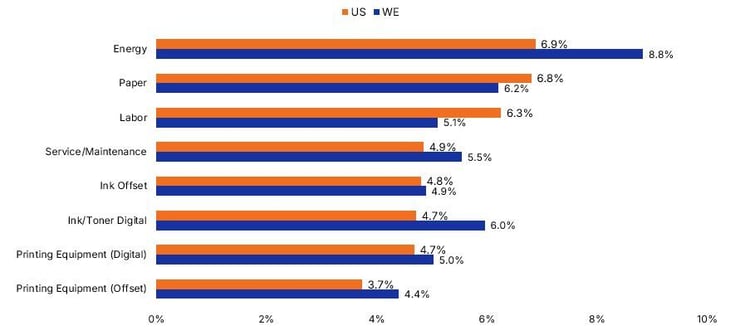
Source: ODS Primary Research US and WE 2026
3. PSPs Are Changing How They Do Business
Cost control remains a priority, with automation and waste reduction ranking as leading drivers of profitability. But PSP response is now going beyond operational efficiency. We are seeing clear changes in commercial behavior:
Shorter quotation validity periods
More frequent price adjustments
Greater use of surcharges and escalation clauses
Increased outsourcing and supply chain flexibility
At the same time, production strategies are evolving. Sustained cost pressure is accelerating the move toward greater workflow automation and more localized or distributed production models.
4. OEMs Need to Respond Beyond Cost Control Measures
Equipment manufacturers are also adapting to this new environment. Tariffs and trade friction are forcing OEMs to rethink pricing, cost structures, and even manufacturing workflow and footprints.
Keypoint Intelligence’s latest digital printing forecast suggests:
Around 10% increases in digital print equipment and supplies
Approximately 7% increases in service costs
However, pricing is just one part of the story, with OEMs also investing in supply chain diversification and localization strategies, among other things. This points to something more fundamental and a long-term industry design rethink.
5. Rising Costs Underline the Need to Sell the Value of Print
It would be natural to assume that rising costs will reduce print volumes. While some print volumes may decline due to reduce orders and run lengths, print itself remains firmly embedded in communication strategies. Today, nearly 90% of organizations still use a mix of print and digital channels, and hybrid models are expected to remain dominant.
As costs rise, print is becoming more selective, more targeted, and more focused on impact. What is imperative is to make sure that print is used where it brings more value, which is linked to any communication/marketing key objectives (i.e., capturing attention, elevating perceptions of value of the advertiser/communicator, being relevant, and enabling purchases).
Higher-quality substrates, embellishments, and personalized applications are not just creative choices, they are functional and strategic ways that lead to more effective communication and, therefore, a more positive return on investment (ROI) for print buyers.
What Should PSPs Do?
In a higher-cost environment, the challenge for PSPs is not just managing costs but competing more effectively.
Their key priorities must include:
Tightening pricing discipline and reducing exposure to volatility.
Investing in automation and workflow efficiency.
Shifting toward higher-value applications and services.
Reframing print around ROI and campaign effectiveness.
So, What Happens Next?
Cost pressures are unlikely to ease in any meaningful way. Tariffs, geopolitical uncertainty, and structural supply chain changes suggest that volatility will remain part of the landscape.
But these pressures are also driving change and opportunities.
For many PSPs and OEMs, that shift is already underway from absorbing costs to managing them, from competing on price to help print buyers get a better ROI, and from short-term adjustments to long-term strategic change. In that sense, rising costs may be doing more than squeezing margins; they may be accelerating the next phase of transformation and greater business sustainability and growth for our printing industry.
Log in to the InfoCenter to view the full Analysis (“Tariffs, Rising Costs, and Market Response”) through our Production Print On-Demand Advisory Service. Not a subscriber? Contact us for more information.