

AI Solutions
AI-Powered Business Execution Platform

Artificial intelligence might be able to increase printed pages, but not without help
Check out Keypoint Intelligence's On Demand Printing & Publishing Services!
The printing market—like every other industry today—is working to identify where artificial intelligence (AI) can deliver the most meaningful value. We are no longer just seeing ideas and experimentation, but real implementation across multiple areas of the print production ecosystem.
Most AI-driven solutions today are focused on improving operational performance. These include production efficiency through automation, predictive maintenance, waste and energy reduction, enhanced operator user interfaces (UI), improved image quality, and even data security. These are all important advancements, but the question remains:
Is this enough?
Efficiency Alone Won’t Solve the Bigger Challenge
AI can absolutely help print providers operate more efficiently. However, higher productivity on the production floor becomes far less impactful if overall print volumes continue to decline, as we are seeing across the market today.
This is why AI must also play a role beyond operations.
To truly influence the long-term growth of digital printing, AI must also help improve campaign productivity and effectiveness. That would increase the perceived value of print and ultimately help generate larger print volumes—without a doubt, this is something everyone in the print supply chain wants and needs.
Why Print Still Matters in Marketing
I continue to believe that print is one of the strongest communication channels. I have spent much of my career in the industry, yes, but print aligns naturally with the core objectives marketers and communicators are trying to achieve.
Print supports campaign success by enabling:
Attention and perceived value through impactful mail experiences, embellishments, premium substrates, unique finishing, and personalization.

Print can also activate one of the most powerful channels in marketing: word of mouth. Specialty applications, tactile experiences, and highly personalized communications create moments people notice and often share.
Marketers recognize this value. In one of our surveys, only 5% indicated they would not be purchasing specialty print applications and products such as those mentioned above.
So Why Are Volumes Still Declining?
There is no doubt that print remains relevant and effective. But in an increasingly competitive media environment where many channels can reach larger audiences, with a fast time to market and a low cost, print needs all the support it can get to keep adding value for buyers.
This is where AI has an opportunity to change the equation.
AI should be able to recommend the most effective channels for a promotion and communication, through omni-channel software tools or traditional searching using AI—and print should be one of them, especially when it directly supports core campaign objectives.
Highly targeted digital print campaigns, particularly those that include personalization, can significantly improve effectiveness. But they also introduce complexity and slow the time to market. AI could help simplify segmentation, profiling, personalization workflows, and campaign tracking, making it easier for marketers to take advantage of such high value communications via print.

Print Isn’t Showing up in AI Recommendations
Despite all these strengths, print volumes continue shifting toward electronic and digital channels. The biggest threat is that the differential value of print is not fully recognized—not by the marketing universe, and now not by AI either.
“What are the most effective channels to communicate?” That’s what I asked AI to answer, but print did not even appear in the list.
We all know AI does not “decide” in the human sense. It responds based on the data it has been trained on and the information it sees across the universe of content. That means print is not showing up because, in the broader market narrative, it is not being prioritized as a top communication channel.
Instead, AI recommended channels such as email, paid search and organic search, social media (including paid ads), events and webinars, as well as messaging (SMS).
So print is strategically powerful because it aligns with key campaign objectives, yet it is not recommended by AI as a top channel. Why?
We Are Still Talking About Print the Wrong Way
We tend to communicate/promote/sell print’s value through products (direct mail, catalogues, brochures, etc.) and applications (variable data printing, embellishments, QR codes, etc.). But we rarely promote print connected to campaign strategy, methodology and objectives in a way marketers can immediately see print value and potential ROI.
Most case studies only focus on the high-level problem, printing products/applications (the channel solution), target/audience, and the outcome/results, which lack the strategic explanation behind the success and does not teach or promote where print works best and how to use it effectively. Remember that print, even though it’s a very effective premium channel, could have higher costs, slower time to market, and even a limited reach, therefore it needs to be sold based on value and potential ROI.

Even AI’s “Print Answer” Is Still Too Narrow
When I asked AI where print should be used in marketing, the response was: “Print marketing is highly effective for building brand trust and driving local engagement, particularly through direct mail, brochures, billboards, and event materials. It is best used for tangible brand reinforcement, such as high-quality brochures, personalized postcards, business cards, and product packaging, or in public spaces like retail, airports, and gyms.”
Even here, the framing is still largely driven by product, and it positions print mainly around branding and local engagement. While print excels in those areas, it can support many other strategies and campaign objectives beyond that narrow scope, too.
The Opportunity: AI Can Help Print Grow, If We Help AI Understand Print
The good news is that AI will make it easier for marketers to implement high-value communication through improved targeting and personalization, where digital print can play a major role. But the challenges remain: Marketers have more channels than ever to choose from, and print as ahigh premium channel (higher cost) will not win by default.
To increase digital print volumes, we must do a better job as an industry of clearly promoting print’s strategic value (alone or complementing other channels) within the context of campaign/marketing processes and objectives.
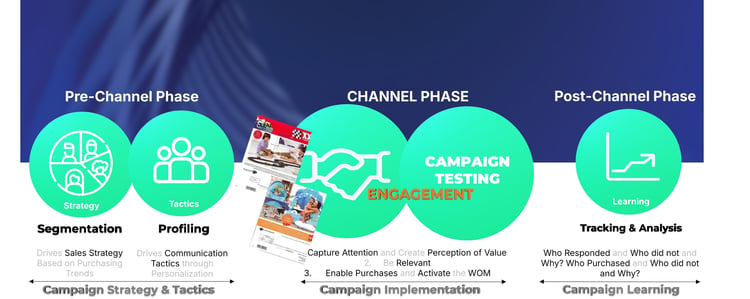
Our natural tendency is to focus on production efficiency because it is at the core of our business. But today, efficiency alone is not enough. We need print volumes to grow, and that requires a stronger focus on demonstrating where strategically print is most effective and why.
Are you interested in promoting the value of print to print buyers? Send me an email at german.sacristan@keypointintelligence.com and let’s talk!
Stay ahead in the ever-evolving print industry by browsing our Industry Reports page for the latest insights. Log in to the InfoCenter to view research on print buyers' communication strategies through our On Demand Printing & Publishing Advisory Service. Not a subscriber? Contact us for more information.