

AI Solutions
AI-Powered Business Execution Platform
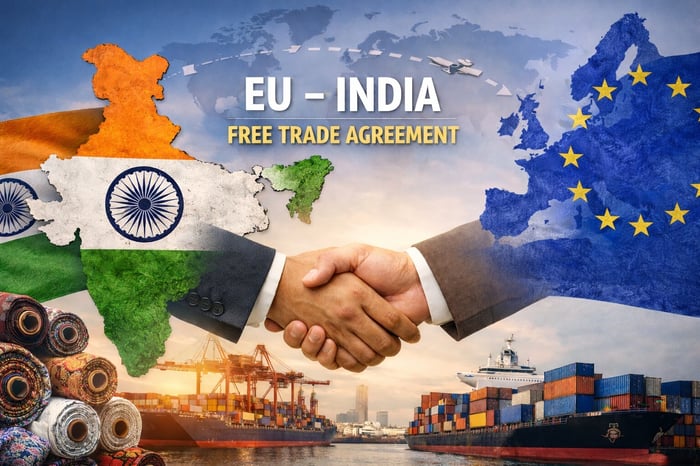
Tariff reductions, market access, and strategic shifts across EU and Indian textile value chains
Check out Keypoint Intelligence's Textile & Apparel Printing Services!
The European Union and India signed a landmark free trade agreement (FTA) on July 24, 2025, marking a strategic expansion of bilateral economic relations between two of the world’s largest economies. However, it is only in early 2026—highlighted by recent coverage such as the BBC’s January 27, 2026 report—that the agreement’s operational implications are beginning to materialize across key sectors. The textile and apparel industry, and particularly the segment dealing with printed textiles, stands out as one of the principal beneficiaries of the deal as implementation begins.
Although the agreement was formally concluded in mid-2025, subsequent months were devoted to ratification procedures, regulatory harmonization, and sectoral adaptation in both countries. With the agreement expected to enter into force in the first half of2026, businesses in the textile sector are now preparing to operate under a significantly liberalized trade framework.
Tariff Elimination and Market Repositioning
One of the most direct and impactful provisions of the agreement is the elimination of nearly all tariffs on Indian exports to the EU. Historically, Indian textiles and clothing products entering the British market faced duties ranging from 8% to 12%, which impaired competitiveness relative to exports from countries like Bangladesh and Vietnam that already benefited from preferential access. Under the new FTA, Indian textile products, including printed fabrics, will enter the EU with zero or near-zero duty. This change directly reduces the cost base for Indian exporters, allowing them to compete more effectively on price in a mature and design-sensitive market.
India’s textile and apparel industry is one of its largest employment generators and export earners. Clusters such as Tiruppur (knitwear), Ludhiana (woolens), and Surat (printed and woven textiles) form the backbone of this industry. Surat is poised to gain significantly, given its dominance in printed textile manufacturing, including both traditional screen printing and modern digital printing methods. Lowering the tariff burden on these exports opens the door for increased volumes and market penetration across the fashion- and home-textile segments in the EU.
SME Growth and Bilateral Innovation
The agreement also presents acritical opportunity for India’s small and medium-sized enterprises (SMEs),which make up a substantial portion of the textile production base. These firms have long faced structural disadvantages due to the high tariff environment and compliance costs associated with EU market entry. With tariffs effectively removed, SMEs can now scale operations, pursue new buyers, and reinvest margins into process innovation and quality enhancement. This is particularly relevant for printed textiles, where design, coloration, and finishing differentiate products in a competitive market.
Furthermore, the FTA encourages deeper bilateral collaboration in higher-value segments, including technical and performance textiles. EU companies seeking reliable suppliers of specialized printed fabrics for sportswear, industrial applications, or interior design now have greater incentive to source from India. At the same time, Indian manufacturers stand to benefit from partnerships that leverage British strengths in textile design, sustainable materials, and advanced finishing technologies. This potential for value-chain integration reinforces India’s positioning not only as a cost-effective supplier but as a strategic production partner, too.
Compliance and Sectoral Readiness
Nonetheless, certain non-tariff barriers remain, which could shape how quickly and effectively Indian exports scale. Regulatory compliance with EU product standards, origin verification protocols, and environmental certifications will continue to be essential. Indian exporters will need to invest in quality assurance systems, sustainable processing methods, and transparent documentation practices to maintain eligibility and competitiveness.
The structural advantages introduced by the trade agreement provide a clear pathway for market expansion, but long-term competitiveness will depend on how effectively the textile sector responds to shifting regulatory and consumer expectations. With implementation underway, the textile sector is well positioned to benefit from the new trade dynamics, provided it continues to invest in compliance, quality, and innovation.
Keypoint Intelligence Opinion
From my perspective, the EU-India trade agreement presents more than just an opportunity for volume growth: It introduces a critical inflection point for printed textile producers. While tariff removal enhances cost competitiveness, long-term market share will be determined by the industry’s ability to meet escalating demands for sustainable production, digital print precision, and faster turnaround cycles. Buyers in the EU are increasingly valuing supply chain transparency, certified eco-friendly processes, and responsiveness to design trends. If Indian producers treat this agreement as a catalyst for strategic modernization, rather than simply a tariff advantage, the sector could gain not only in export volume but also in global reputation and value creation. On the other hand, failure to adapt to these expectations could blunt the competitive edge that the agreement offers, making this moment as much a test of readiness as it is an opening for growth.
Stay ahead in the ever-evolving textile printing industry by browsing our Industry Reports page for the latest insights. Log in to the InfoCenter to view research and studies through our Textile & Apparel Printing Advisory Service. Not a subscriber? Contact us for more information.