

AI Solutions
AI-Powered Business Execution Platform
Company positions post-quantum cryptography as an immediate procurement criterion, not a distant concern
Check out Keypoint Intelligence's Workplace Advisory Services!
HP Inc. hosted its annual Industry Analyst Security Summit in December 2025, with print security sessions emphasizing an urgent message: As quantum computing advances, today’s widely used asymmetric cryptography methods may become vulnerable, making post-quantum readiness a consideration for procurement decisions now, not later.
The Quantum Threat: Immediate and Escalating
More immediately, HP highlighted the Harvest Now, Decrypt Later (HNDL) threats to data, where bad actors have been capturing encrypted traffic with the intent to decrypt it once quantum capabilities mature. While these HNDL attacks focus on data transmission, from HP’s perspective, this is another real-world proof point that quantum threats against IT infrastructure are coming sooner than many believe.
While quantum resistant protection of data is a focus, another immediate requirement for printers, HP outlined, was establishing a hardware-enforced foundation of quantum resistance. Upgrading hardware with quantum-resistant protection is a priority because hardware upgrades are optimized during manufacturing, not during product lifetime. Without upgraded hardware, broken asymmetric cryptography could enable attackers to inject malicious firmware, gain device control, move laterally across networks, and ultimately trigger ransomware attacks. This quantum threat is not centric to just endpoints, wherever asymmetric cryptography touchpoints live in today’s IT infrastructure, a quantum computer breaking this cryptography will expose all touchpoints to myriad attacks by threat actors.
World’s First Quantum-Resistant Printers
HP previewed quantum-resistant printing capabilities, including their go-to-market rollout of what it describes as the “world’s first quantum-resistant Enterprise printers.” HP indicated that Enterprise-class platforms now possess quantum-resistant capable hardware as of this past October 2025 for A4 Enterprise, and December 2025 for A3 Enterprise devices from HP factories.
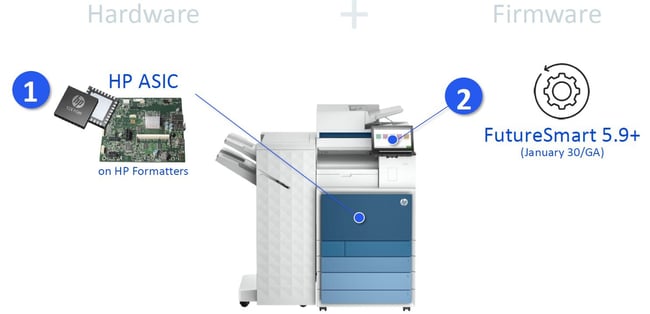
Select HP Enterprise models include an on-board ASIC that makes them field-
upgradeable to withstand future quantum-computing attacks (Source: HP).
For these A3 700-800 Managed and 8000 Transactional series and A4 500-600 Managed and 5000-6000 Transactional series MFPs and printers, customers can choose to enable quantum resistance using HP’s upcoming FutureSmart Firmware version 5.9.2.3 at a time of their choosing through Embedded Web Server (EWS) and Web Jetadmin (WJA) enablement. Unique to the print industry, this will bring quantum-resistant cryptography into BIOS/firmware integrity protection, helping defend against emerging cryptographic threats as quantum computing matures.
These devices implement quantum-resistant cryptography at the BIOS firmware integrity layer using LMS (Leighton-Micali Signature) in addition to RSA, for defense-in-depth. These protections are rooted in the hardware of HP’s ASIC. According to HP’s positioning, quantum-resistant cryptographic schemes designed to protect BIOS firmware integrity, combined with automatic self-healing recovery, are currently focused on Enterprise print devices. HP also introduced HP Wolf Pro Security, a new tier intended to bring advanced protection to business-class devices, including write-protected memory, automated firmware updates and more.
Keypoint Intelligence Opinion
HP’s quantum resistance messaging stood out not because post-quantum cryptography is a new concept, but because HP is positioning quantum readiness as a near-term procurement consideration, rather than a distant planning exercise. With US government timelines calling for quantum-resistant cryptography in new National Security Systems acquisitions starting in 2027, organizations with multi-year refresh cycles may need to factor post-quantum readiness into purchasing decisions sooner than expected.
If HP executes its roadmap for quantum-resistant printing, it could raise the bar for secure printing and accelerate broader market attention on post-quantum protections at the firmware and platform integrity layers. For organizations evaluating print infrastructure over the next few years, particularly those supporting government clients or operating in regulated environments, HP’s post-quantum cryptographic positioning should be on the shortlist. Endpoint security increasingly matters at procurement time, not as an afterthought. Updating enterprise print fleets to post-quantum cryptography will take time so it is vital to plan today for this future-ready fleet posture across your environments.
Stay ahead in the ever-evolving print industry by browsing our Industry Reports page for the latest insights. Log in to the InfoCenter to view research on cybersecurity through our Workplace CompleteView Advisory Service. Not a subscriber? Contact us for more information.
.jpg)


