

AI Solutions
AI-Powered Business Execution Platform

How small steps can close the automation gap
Check out Keypoint Intelligence’s Production Workflow Services!
The concept of robotics in business has long been viewed as a futuristic “someday solution.” Sure, we’ve seen a few robotics demonstrations at trade shows and some early adopters cautiously experimenting with basic solutions, but adoption and use haven’t been widespread by any means. Although we still have a long way to go, new global research from Keypoint Intelligence suggests that robotics use is beginning to shift from experimental to strategic.
Today’s businesses are struggling to accomplish more with less due to rising costs, an aging workforce, and ongoing labor challenges. Workflow automation is more important than ever, and robotic solutions (even if they are simple at first) are becoming an attractive way to automate. Companies are working to determine how robotics might fit into their existing workflows to increase efficiency, improve safety, and reduce strain on human employees.
In early 2026, Keypoint Intelligence conducted a global survey of 179 total respondents to gain a better understanding of the current state of robotics adoption as well as near-term plans. Almost all respondents were based in North America or Western Europe. Here are some top-level findings from the survey:
The greatest share of respondents (46%) were commercial printers, followed by book printers/publishers (16%).
Respondents reported an average of 203 total employees, but over a quarter had fewer than 50.
Common job titles for respondents included Print Services Manager/Supervisor/Director (24%), Print Production Manager/Director (21%), and Owner/CEO/President (19%).
The most significant business concerns among total survey participants were rising costs (29%) and keeping up with technological advancements (24%).
Over the past decade, many organizations have invested in various workflow automation solutions to streamline decision-making and reduce inefficiencies. Some of the more common solutions include management information system (MIS) platforms, production analytics, and automated job routing. Unfortunately, physical execution within production facilities still frequently relies on manual intervention. As a result, software-driven workflows slow down at human handoff points.
Robotics can extend automation in a physical environment by linking digital workflow directly with material movement and execution. At this time, however, robotics implementation is low with less than 10% of total respondents having already deployed such a solution. More encouragingly, nearly three-quarters of respondents were actively seeking a robotics solution or considering one for the future.
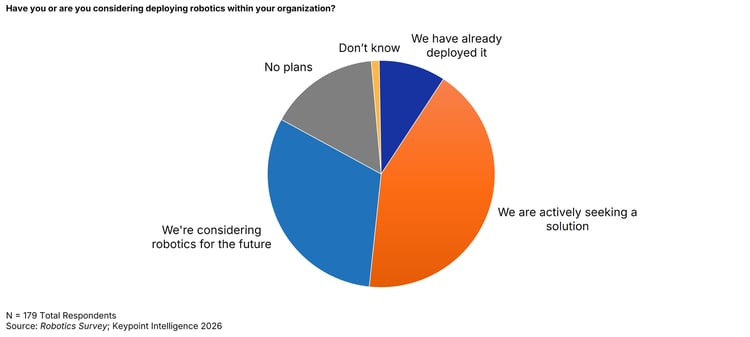
It is interesting to note that while only 9% of respondents in Europe had no plans to deploy robotics, the same was true for 23% of respondents in North America.
Keypoint Intelligence’s survey data indicates that businesses are taking a steady and pragmatic approach to robotics. Instead of working to fully automate production lines, they are focusing on specific operational bottlenecks and deploying robotics solutions where they can deliver immediate results. When respondents were asked specifically what their robots were or would be doing, the most popular uses were moving media/substrates to or from the press/production floor.
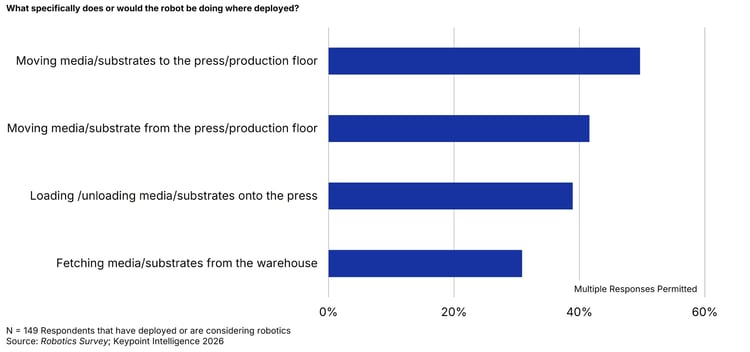
All the tasks in the figure above share a common characteristic, and that’s repetition. These tasks can be labor-intensive but are performed over and over in a consistent manner, making them ideal candidates for robotics. In these situations, robots can deliver marked performance improvements while minimizing implementation risks.
Modern businesses are implementing robotics to solve immediate operational challenges. Of course, this may change over time as firms become more comfortable with the technology. The industry is still in an early adopter phase, so it makes sense that people want to test the waters first.
Among firms that are considering robotics but have not yet implemented them, some common barriers remain. Not surprisingly, survey participants most frequently cite budget/cost constraints, a high capital expenditure, and uncertainty about ROI or benefits.
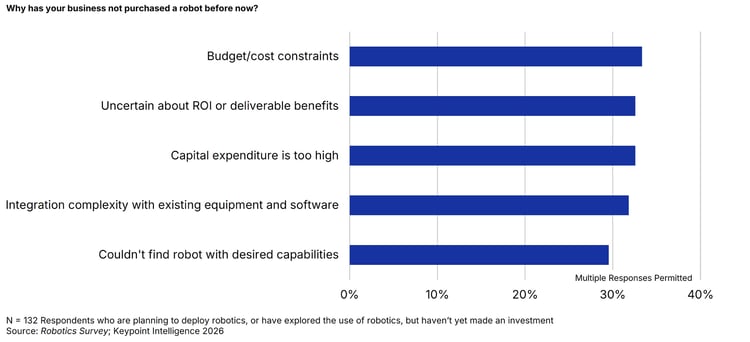
Production businesses want evidence that robots can increase profitability and ultimately succeed in environments very similar to their own. Proven use cases, peer experiences, and real-world outcomes will play a critical role in moving organizations forward on their robotics journeys.
It might still seem futuristic, but robotics is poised to become a practical extension of workflow automation. We’re still in the early stages, but the message is clear: Most organizations are actively exploring how robotics can help them address labor shortages, rising costs, and operational inefficiencies in the future. Rather than attempting sweeping transformations, businesses are taking a measured approach by deploying or considering task-specific robots that target repetitive, high-impact bottlenecks. In addition to delivering immediate results, this approach can build confidence in robotics as it becomes a reliable part of the production ecosystem.
Keypoint Intelligence’s recent in-depth survey results cover the emergence of robotics on a global scale. Robotics is the key to true hands-free production, but it’s important to think strategically and start small. Learn more about robotics or purchase our research today.